Write SEO Title Tags That Get 3x More Clicks [Formula]
꧁ Digital Diary ༒ Wefru – India's Largest Writing Community ༒ Read, Write & Grow ༒꧂
꧁ Digital Diary ༒ Wefru – India's Largest Writing Community ༒ Read, Write & Grow ༒꧂
Scan QR code to visit our website
Title tag play a major role in attracting traffic to your wefru website. On your website, the title shows up in the tab at the top of the browser
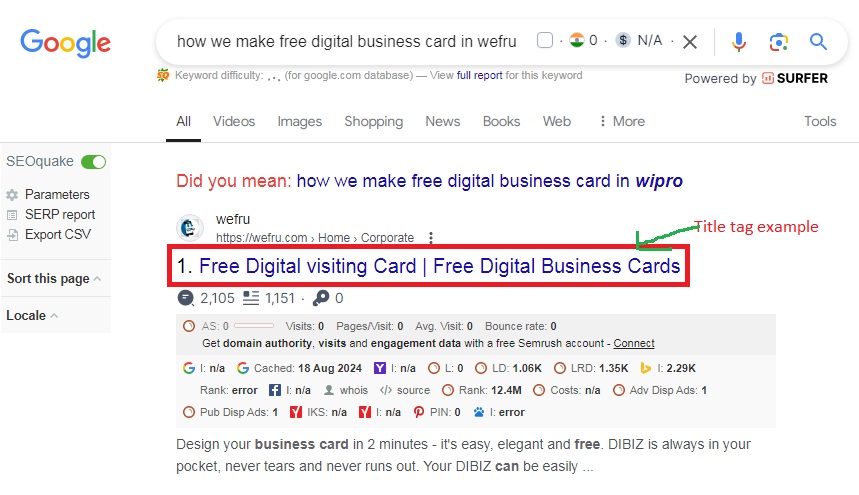
On the search engine results page (SERP), the title is the main part of a site's listing. It shows up in blue, in bigger font than everything else, and is hyperlinked back to your website.
1. Write unique titles for every page.
2. Pay attention to length.
3. Use your target keyword (but don't overdo it).
4. Be descriptive of what's on the page.
5. Make a (brief) case for what's on the page.
Let's get a better understanding of what a title tag is first. A title tag is an HTML code tag that can be found on almost every page. Here is how it looks in the Wefru code.
When seen in the SERPs, a title tag typically looks like this example of the clickable text reading "how we make free digital business card in wefru":
Every page on your website is unique and your title tags should reflect that. Make sure you customize the title tags on each page of your website so that they accurately describe what's on that specific page. You want your title tag to signal to search engines what the individual page is about.
Plus, having a clear and accurate title is more useful to anyone who sees the page in the search listings.
Google and other search engines will display 50-60 characters of a title tag in the search results before cutting it off, so you should generally aim for title tags that are around 50 characters or less.
To be safe, you want the most important or descriptive words in the keyword toward the beginning so they're less likely to get cut off. If you like to include your brand name in every title tag (which can be a good idea for recognizable brands), put it at the end, behind the words that describe what's on the specific page.
Every page on your website should answer a question or provide valuable information someone will be searching for. Your website will be more useful to those people if it shows up in search for the right term – just when they're looking for the information you provide. So for each page, you should have a target keyword (or a few) in mind.
Since Google's algorithm uses the title tag as one of the main ways to determine what a page is about, it's a good opportunity for you to include the main keyword or keywords you're targeting for that page. That makes it clear to Google that this page is relevant for anyone searching for that specific term. Just make sure not to fall for keyword stuffing.
When your web page does show up in search engines, a lot of people will decide whether or not to click based on your title tag. If they click and come to a web page that isn't what they expect based on the title, they'll likely click that back button right away and look for another result to try.
You want your title tag to provide an accurate description of what people will see when they choose to visit the web page. When people's expectations match what they see on the page, it means a lower website bounce rate and a longer time spent on the site – metrics that signal to Google your page is valuable and should keep ranking high.
More importantly, it creates a better experience for your visitors. You want every visitor to like what they see and hopefully come back for more. If your title tag isn't clear, that's less likely to happen.
You don't have a lot of space for this, but use what you have to differentiate what makes your web page so great. Often this can be accomplished by adding an adjective in front of the descriptive keyword or additional description behind it. For blog posts and articles, a good title tag often looks a lot like a good headline, so you may be able to use the headline you've already written.
Make sure you really think about what on the page is most valuable or important to your target audience. Your title tag should emphasize the value your page provides to them.
Think of your title as a mini-advertisement. It has two main jobs:
Tell Google what the page is about (SEO).
Persuade a human to click on it (The Hook).
A powerful structure that combines both is:
[Hook/Adjective] + [Primary Keyword] + [Clarifier/Benefit] | [Brand Name]
Hook/Adjective: This is your catchy word. It creates emotion or intrigue.
Primary Keyword: This is what people are searching for. Be specific.
Clarifier/Benefit: This answers "What's in it for me?" for the user.
Brand Name: Builds brand recognition and trust.
Let's apply this formula with catchy words and hooks.
1. For Yourself (Personal Brand/Portfolio)
Your goal is to stand out and show your unique value immediately.
Bad Example: John Doe - Web Developer
Why it's weak: It's generic, has no hook, and doesn't explain your value.
Good Examples (using hooks):
The Problem-Solver: John Doe: Full-Stack Developer Transforming Ideas into Scalable Apps
The Result-Getter: Drive Growth: John Doe - Data-Driven Marketing Manager
The Authority: Award-Winning UX Designer | Creating Intuitive Digital Experiences | John Doe
The Direct & Bold: Hire a Web Developer Who Actually Cares About Your ROI
Catchy Words to Use: Award-Winning, Top-Rated, Expert, Strategic, Creative, Reliable, Certified, Proven, Transformative, Data-Driven
2. For Your Organization/Company
The goal is to establish what you do and why you're the best choice.
Bad Example: Wefru - Digital Solutions
Why it's weak: "Digital Solutions" is vague. There's no hook or specific benefit.
Good Examples (using hooks):
The Benefit-Driven: Wefru: Effortless Digital Tools to Supercharge Your Business
The Niche-Focused: Wefru: The #1 Platform for Seamless Team Collaboration
The Trust-Builder: Trusted by 10,000+ Businesses: Wefru's Secure Cloud Solutions
The Simple & Clear: Free Digital Business Cards | Instantly Share Your Contacts | Wefru
Catchy Words to Use: *#1, Leading, Trusted, Premier, Innovative, Seamless, Effortless, Secure, Scalable, All-in-One*
3. For Your Products
The goal is to highlight the key feature and the main benefit that solves a user's pain point.
Bad Example: Wefru CRM Software
Why it's weak: It's just a product category. There's no reason to click.
Good Examples (using hooks):
The Pain-Point Solver: Stop Losing Leads: Wefru CRM with Automated Follow-Ups
The Feature-Focused: All-in-One CRM | Sales, Marketing & Support in One Platform | Wefru
The Time-Saver: Automate Your Sales Pipeline in 5 Minutes with Wefru CRM
The Bold Claim: The Simplest CRM Ever Built - Try Wefru Free
Catchy Words to Use: Stop [Pain], Automate, Simplify, All-in-One, Powerful, Easy-to-Use, New & Improved, Ultimate
4. For Your Services
The goal is to be specific about the outcome you deliver.
Bad Example: SEO Services by Wefru
Why it's weak: Too broad. Every SEO agency uses this. No hook.
Good Examples (using hooks):
The Result-Focused: Get Page 1 on Google: Proven Local SEO Services | Wefru
The Guarantee-Driven: Grow Your Revenue with Our Data-Backed SEO Strategy
The Niche-Specific: E-Commerce SEO: Optimize Your Shopify Store for More Sales
The Question Hook: Need More Website Traffic? Our SEO Service Delivers Qualified Leads
Catchy Words to Use: Proven, Guaranteed, Results-Driven, Data-Backed, Scalable, Expert, Custom, ROI-Focused
The formulas above are already SEO-friendly, but here's why they work so well for both search engines and AI:
Front-Load Your Primary Keyword: Both Google and users scan from left to right. Placing the most important keyword early (e.g., "E-Commerce SEO," "All-in-One CRM") sends a strong relevance signal.
Natural Language & Context: AI (like Google's RankBrain) understands context, not just keywords. A title like Automate Your Sales Pipeline in 5 Minutes is packed with semantic meaning ("quick," "easy," "efficient") that a simple CRM Software title lacks.
Satisfies User Intent: Your titles answer a question, solve a problem, or fulfill a need. This leads to higher click-through rates (CTR), which is a major ranking signal. When users click and stay on your page, Google learns that your result was good and may rank it higher.
Avoids Keyword Stuffing: The examples use keywords naturally within a compelling sentence. They don't look like SEO Service, Best SEO, Cheap SEO, Local SEO. This clean, human-friendly approach is exactly what modern AI-powered search algorithms reward.
Use Power Words: Incorporate words that trigger an emotional response-like Free, New, You, Instantly, Secret, Surprising, Ultimate.
Include Numbers: Numbers grab attention and set clear expectations. (e.g., 5 Steps to..., The 2024 Guide to...).
Ask a Question: This directly engages the user who is asking that same question in their head.
Test and Tweak: The best title is the one that gets the most clicks. Use tools like Google Search Console to see which of your page titles have the highest CTR and learn from them.
By using this Hook + Keyword + Benefit formula, you create Meta Titles that are not just found, but are also irresistible to click on.
No FAQ Available.
Verified Brand
At WeFru (operated by Meerut Mart), we believe that talent and capability are everywhere, but global digital access is unequal. Around us, millions of talented individuals, dedicated manufacturers, and expert professionals possess incredible expertise, deep skills, and unwavering dedication. However, in today's highly integrated digital world, talent alone is no longer enough. If people and global buyers cannot find you online, your business and skills remain completely invisible to the world. Today, before purchasing any product or hiring any service, customers across the globe search on search engines or take direct help from Artificial Intelligence. The world... Read More

Have a question about this post? Send it straight to the author — only they will see it.
We are accepting Guest Posting on our website for all categories.
I want to Hire a Professional..
Corporat
Verified Author Expert@DigitalDiaryWefru